
CHICAGO — Beginning with commissioner Tony Petitti, every leading figure who addressed reporters from the primary stage at Big Ten Media Days has been flanked by the last three national championship trophies. These shimmering, cylindrical showpieces symbolize the conference's climb toward college football supremacy. Their visual prominence is simple: For the first time since World War II, the Big Ten has won three straight national championships.
In an era when the Big Ten and SEC keep jockeying for the unofficial title of preeminent conference in collegiate athletics, any opportunities to poke and prod must be taken. "In addition to winning three consecutive titles," Petitti said during his opening remarks on Tuesday morning, "the Big Ten has dominated the first two seasons of the expanded College Football Playoff. Seven Big Ten teams [have] combined for the nation's-best 11 wins, more than double the next closest league." Consider the message delivered and the knife twisted.
If Michigan’s national championship victory three seasons ago finally wrested college football’s biggest prize away from the southern states, whose representatives had hoisted the trophy 17 times over the preceding 18 years, then subsequent wins by Ohio State and Indiana became the tipping point in the sport’s balance of power. Regardless of whether the Big Ten can add a fourth consecutive championship in the coming months, the conference will have another opportunity to upstage the SEC in this year’s Heisman Trophy race. Indiana quarterback Fernando Mendoza snapped a run of 18 consecutive winners from outside the Big Ten, dating to former Ohio State quarterback Troy Smith in 2006.
With a glut of high-end players returning for the upcoming season — many of whom spoke at the Hilton Chicago this week — the league could retain the award for a second straight year. That hasn’t happened since the mid-1970s. "Having big-time players on the stages that they are right now is so healthy for them and the conference," Minnesota head coach P.J.
Fleck when I asked him about the impact of potentially stringing together Heisman Trophy wins. "Because there’s a lot of people here that are going to be Heisman candidates as we talk through the whole year in the Big Ten. And I think the Big Ten is in the best spot it’s ever been." So who are this year’s leading candidates?
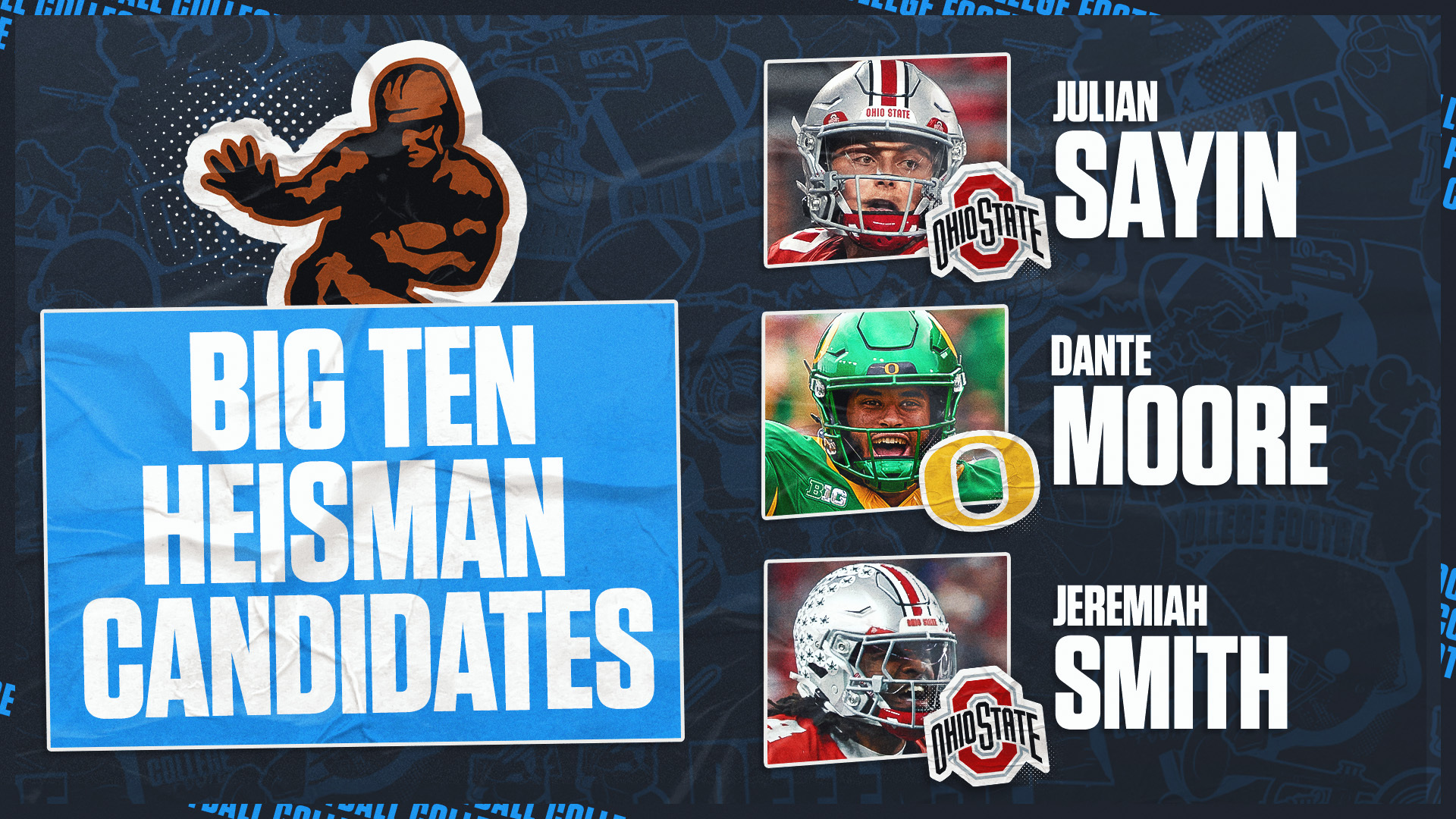
According to the most recent odds from DraftKings Sportsbook, which were updated earlier this week, four of the top eight betting favorites in the 2026 race will play for Big Ten schools: Oregon quarterback Dante Moore (+1000), Ohio State quarterback Julian Sayin (+1200), Indiana quarterback Josh Hoover (+1300) and Ohio State wide receiver Jeremiah Smith (+1400). It’s worth noting that Sayin and Smith finished among the top 10 in last year’s voting, too, as the conference claimed three of the six leading vote-getters overall. The Big Ten winning a second consecutive Heisman Trophy would continue to shift the mantle atop college football.
Two years ago, the Big Ten ranked third in NFL Draft picks produced (42) behind both the SEC (60) and the old Pac-12 (43). By 2025, however, the Big Ten ascended to second with the help of absorbing some of the leading programs from the Pac-12. When coupled with the Big Ten’s current run of national championships, an overall narrowing of the gap seems clear — even as the SEC finished plus-19 in draft choices earlier this year.
"I don’t think people see that as reflective of where the league is — or any league is," former Indiana, LSU and Vanderbilt head coach Gerry DiNardo told me on Wednesday, in between his duties as a Big Ten Network analyst. "Now, if a Big Ten player win it [again this year], there are going to be people saying, ‘We’ve won three championships in a row and two Heisman Trophies.’ So I think people will tag that onto it and make the narrative there. But I don’t think it reflects the league." Legitimate reflection or otherwise, completing such a rare achievement would be attention-grabbing.
Only three times in the history of the Heisman Trophy, which has been awarded annually since 1935, has the Big Ten ever produced consecutive winners, according to FOX Sports Research. There were three straight Big Ten recipients from 1939-41, including Nile Kinnick (Iowa), Tom Harmon (Michigan) and Bruce Smith (Minnesota); there were back-to-back winners in 1954-55 with Alane Ameche (Wisconsin) and Howard Cassady (Ohio State); and former Ohio State tailback Archie Griffin remains the award’s only two-time winner after finishing first in both 1974 and 1975. Beginning around the turn of the century, however, quarterbacks have dominated the Heisman Trophy race.
A victory for Wisconsin running back Ron Dayne in 1999 now feels like the unofficial end to an era with 21 signal-callers lifting the trophy across the ensuing 26 years, including Mendoza last winter. The only non-quarterbacks to win the award during that span were CB/WR Travis Hunter (Colorado), WR DeVonta Smith (Alabama), RB Derrick Henry (Alabama), RB Mark Ingram II (Alabama) and RB Reggie Bush (USC). Exploring what a wide receiver must do to win the award became a popular topic of conversation inside the Hilton Chicago when Ohio State’s contingent addressed the media.
Smith, a unanimous All-American, finished sixth in last year’s voting after catching 87 passes for 1,243 yards and 12 touchdowns. Many coaches, analysts and scouts believe that he was, and still is, the single best player in college football, worthy of being selected No. 1 overall in the 2027 NFL Draft.
Smith faces far longer odds of winning the Heisman Trophy based on his position alone. When asked about that conundrum on Wednesday afternoon, Smith said he’s never quite understood the voting requirements. Because of that, Smith told reporters he’d be happy to wind up on stage as a finalist come December.
"I always felt it was a quarterback award unless you have a crazy season," Smith said. "I don’t really know the criteria of what they look at. Is it the best stats?
Is it the best player? I don’t really know. But we’ll see this year." Smith or not, perhaps the answer will still reside in the Big Ten.


